

Greg Rucka is one of those freelancers who has been screwed not just by DC, but also by Marvel. For DC, he created one of their top-selling titles: Gotham Central. The comic didn’t sell well, but the trade paperbacks are a license to print money, selling out year after year. But DC summarily dismissed him from several projects, including a Wonder Woman project when DC decided they’d sell more copies if Grant Morrison wrote it.
Then, at Marvel, Rucka did a great job re-energizing Punisher. Not since the early Matt Fraction days had Punisher run in the mainstream Marvel Universe—and Rucka put him there, solidly, in a way that made sense. For his troubles, Marvel cancelled the book.
Now, the multiple Harvey- and Eisner-winning writer has moved to novels and creator-owned pastures. Which is too bad, because he’s done some really great stuff for the big two. I guess they don’t get what they refuse to pay for…
BEFORE THE TOP 10: HONORABLE MENTIONS
THE OLD GUARD (Image)

Rucka and Leandro Fernandez tell a tale of immortal soldiers. It’s lots of fun.
THE PUNISHER and PUNISHER: WAR ZONE

Modern takes on Punisher have put him in the Marvel Universe and made him powerful like Batman (sometimes even comically)—like Matt Fraction’s series, Rick Remender’s Frankencastle, and many of the old Punisher: War Journal stories. Or, they’ve taken him into his own universe and done the same—like Garth Ennis’ Marvel Knights work, in which he runs over Wolverine with a steamroller. The other extreme is to make him a serious force of nature, like in both Ennis’ and Jason Aaron’s Punisher MAX runs, who mostly operates outside of the superverse. But, other than a few Frank Miller Daredevil issues, no one has truly combined these perspectives to create a gritty, realistic vigilante who operates in the mainstream Marvel Universe. Rucka did this in his volume of Punisher, in which he joined Frank Castle with a female partner. The books is a very slow build—I didn’t really like the first few issues—but when it picked up speed, it became one of my favorite Punisher books. Pun is one of those guys who is hard to write well, and Rucka was great at it.
When the Punisher book ended, Rucka changed the narrative tone dramatically for a miniseries. Unlike Punisher, Punisher: War Zone doesn’t try to be subtle. It’s an all out brawl: Frank Castle versus The Avengers. If you’re one of those people who thinks Hush or Batman: The Dark Knight are stupid because Batman could never beat Superman, then this isn’t for you. But if you’re looking for a creative, rock-and-roll battle book, this is one of the best I’ve read in ten years.
AND NOW…
THE TOP 10 GREG RUCKA COMICS!

10. BATWOMAN: ELEGY (Detective Comics #854-860)
Yes, this is a predictable entry. For seven issues, Batman ceded Detective Comics to a new character, a Batwoman who emerges from the DC anthology series 52. The art by J.H. Williams is some of the greatest you will ever see—every page is unique, with panel movement and layouts that require your attention and demand appreciation. It’s the comic book equivalent of a John Ford film. As for the story, no knowledge of Bat- or Gotham-lore is required, but it is a complex story that isn’t for casual readers. It’s very good—but this is really JH Williams’ book, not Rucka’s; hence I’m ranking it at #10.
And, of course, this is the book that got Rucka a GLAAD award for creating the first major “out” lesbian superhero.
9. SPIDER MAN’S TANGLED WEB #4

In this done-in-one, Rucka teams up with 100 Bullets artist Eduardo Risso on a story about one of Kingpin’s lieutenants. It has the tone of Gotham Central (see below), in that it’s a gritty, shadowy, human story that takes place in the “super world.” (Incidentally, Joss Whedon will be experimenting with this idea in his new SHIELD television show.) But unlike that series, this story is about the bad guys—not the good guys—and what happens to the ones Spider-Man doesn’t capture after he interrupts their particular criminal enterprise. I wanted this story to last longer than 20 pages, but at the same time, writing a short story in comics can be difficult: There’s not much time to establish relevance, give meaning to the characters, and still tell a tale with a beginning, middle and end. You have to admire Rucka’s skills in this regard. (Note: He won an Eisner for a very short story in the I Am An Avenger anthology about Captain America showing up at a funeral for a man under his command.)
8. WONDER WOMAN: THE HIKETEIA

Greg Rucka won the 2003 Eisner for his work on this book (and on Queen and Country), and then won another in 2004 for his work on the Wonder Woman series. This story gets on my top ten for a couple reasons, not the least of which is that he actually made Wonder Woman interesting. The only other Wonder Woman comic I’ve ever really enjoyed was the first dozen-or-so issues of the New 52 reboot. I’ve read the Gail Simone and George Perez WW books, and I’ve never found them to be anything more than decent. But The Hiketeia is a great book: A girl takes advantage of Diana’s duty to protect humans by seeking amnesty from…Batman. Naturally, there’s a lot of “shades of grey” morality here. Hero-versus-hero books, when done well, are great fun—and this one is no exception.
7. WHITEOUT (Oni Press)

Like Stumptown (below), Whiteout was a 4-issue mini that was followed by another miniseries featuring the same character. The first mini was my favorite, even though it only got an Eisner nomination not a win (Whiteout: Melt won the 2000 Eisner for best limited series).
Steve Lieber penciled this fascinating murder mystery that takes place in Antarctica. It was also Greg Rucka’s first major comic book work.
Like so many of his works, Whiteout was adapted for film … And the comics better.
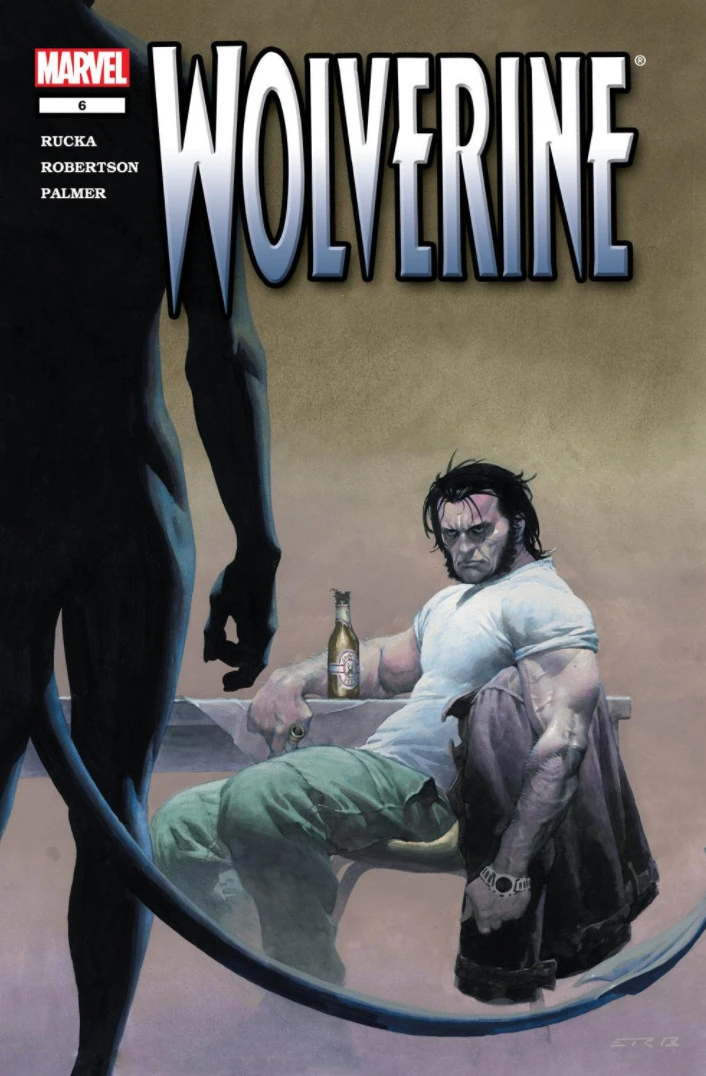
6. WOLVERINE #6 (Marvel)
Another example of a Greg Rucka short story. In this done-in-one titled, “So, This Priest Goes Into a Bar,” Wolverine and Nightcrawler drink over lost comarades. It’s a very “human” examination of good and evil, and a great example of why the Logan-as-killer/Kurt-as-Catholic dynamic was always one of the most interesting relationships in the Uncanny X-Men. Plus: Darick Robertson did the art chores.

5. STUMPTOWN (Oni Press)
Greg Rucka really knows how to write female leads. Stumptown, created by Rucka and artist Matthew Southworth, was a 4-issue mystery about a private eye in Portland who takes on a dirty client because she has a gambling debt. The first series is very noir, very gritty, and feels like a novel. I wasn’t that big a fan of the second Stumptown comic—it was good, but not nearly as good. But this first mystery is a great book for fans of Brubaker and Phillips’ Criminal series.
DON’T LET THE MEDIOCRE T.V. ADAPTATION FOOL YOU! Stumptown is a really, really good comic.
4. LAZARUS (Image)

Not just another “dystopian future with karate” story–Rucka mixed in elements of internal family struggle, wealth disparity, slavery, and gender roles. And karate. Thing HBO’s Succession meets Bruce Lee.
3. BATMAN: NO MAN’S LAND (DC)

The biggest irony of Rucka’s being mistreated by Marvel and DC is that he’s such a great team player. Whether he was writing with Ed Brubaker on his brilliant Gotham Central work, or participating in big events like 52 or Crisis, he always made sure to match the tone and concept of his fellow creators. In that capacity, Rucka wrote several installments for the 1999 Batman event, “No Man’s Land.” If you haven’t read it, you should: It’s the best non-Grant Morrison extended Bat-comic I’ve ever read. In the story, Gotham City is walled off from the world (think: Escape from New York) and taken over by roving gangs. Batman slowly, gradually, takes it back.
The book sowed the seeds for Gotham Central by focusing on the GCPD (mostly James Gordon, Rene Montoya and Harvey Bullock), and having extended focus on other minor characters like Sarah Essen (Gordon’s wife).
The writing in this year-long even was terrific. Rucka was only one of several great writers on it, but his stories were among the best.

2. QUEEN AND COUNTRY (Oni Press)
Queen & Countryis the rare example of a comic book inspired by (but not actually associated with) a TV show—The Sandbaggers. Rucka’s comic was a series of stories following Tara Chace, an agent in Britain’s SIS spy division. Each story arc told the story of one of her missions, and while there were recurring themes and characters, any volume of Q&C can be read on its own. It reads like HBO’s The Wire, or the great BBC program MI-5, in that it focuses more on intrigue, politicking and bureaucracy than action (although there is quite a bit of action), and is reality-based. There were multiple story arcs and 32 proper issues of the series, and I recommend all of them—but if you’re just looking to wet your beak, you might focus on “Broken Ground” (issues #1-4, reprinted in volume 1), which introduces the characters and sets the tone for the series—and has incredible art by Steve Rolston. It won the Eisner for best new series, and got two other 2002 nominations. Operation: Stormfront is another great one—with art by Eisner-nominated Carla Speed McNeil. It’s a more intimate story that focuses on the death of a field operative. The series got several other Eisner nominations throughout its run. Really great non-cape comics.
And an interesting bit of Wiki Trivia: Tara Chace looks a lot like Lily Sharpe from Rucka’s Whiteout comics, and there are some Easter eggs in Whiteout that suggest that they may in fact be the same person. Rucka said he considered that, but later decided not to make them the same character.

1. GOTHAM CENTRAL (DC)
It’s almost unfair to consider this one entry in my top ten, since he wrote about a half-dozen separate stories in this series, but I’m doing it because I can’t possibly choose just one as the best of the lot. Or just two. This comic, including the issues written by Ed Brubaker, is one of my favorite of all time. I borrowed the trades from my library twice, then bought them, then bought the reissued versions. So I’ve probably read it straight through at least five times, and I wrote about it here.
If I had to pick a few choice tales, I’d have to include “Soft Targets,” a horrifying tale drawn by Michael Lark and Stefano Gaudiano in which Joker decides to become a sniper, randomly killing Gothamites and torturing cops. But my favorite would be the Eisner AND Harvey award-winning “Half a Life,” in which Renee Montoya is publicly outed and has to deal with the repercussions of being a lesbian in a male-dominated, macho police department—with art by Michael Lark. Rucka thusly was responsible for two major lesbian characters at DC!
Note: He also shared two 2003 Eisners with Ed Brubaker and Michael Lark for his work on Gotham Central. Well deserved.