

Here’s a tribute to one of my all-time favorite Batman series. It would mark the end of Grant Morrison’s incredible run with the character.
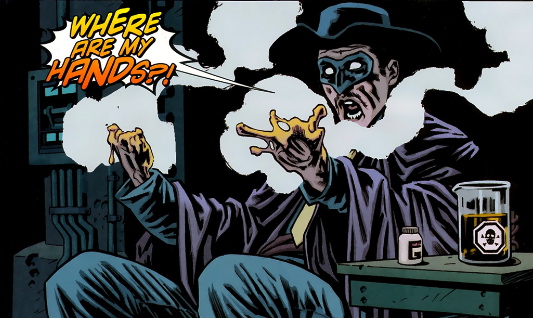
As a result of events from the Grant Morrison Batman stories that preceded it (and picking up directly after the end of Morrison’s Batman and Robin series), Batman has realized that he needs his extended cast in order to operate most effectively and not be completely sullen and miserable all the time. He also needs to go global to take on Leviathan–an international criminal organization.
And along the way: Sheer, joyous, random lunacy. Grant Morrison remembers that comic books are supposed to be fun, and rapid-fire introduces characters and ideas like Lord Death Man and a Fishing School for Evil.
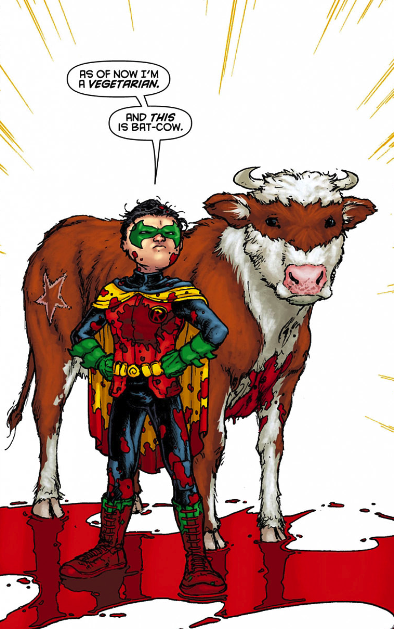
And Bat-Cow.

After the silliness of the first two issues, Morrison digs in deep to the “Oroboros” conspiracy, and ressurects the original Batwoman–Kathy Kane–at least through flashbacks. Turns out, Talia wasn’t the first female to try to make a family man out of Batman. And Batman’s territoriality over his copyrighted name extends far back as well….

In the story proper, we see Batman as a superspy. Along with Batwoman and El Gaucho, the team learns that Leviathan has plans to infiltrate Batman, Inc. (A traitor is also what destroyed the League of Heroes way back in this story arc, which also took place on an island. We learn that Ouroboros is a destructive element, and the bad guy wants to use it to blow up the island.
The story also introduces the global element of Batman, Inc., by showing us Batwing–the Batman of Africa. It’s a little odd that Argentina gets its own crusader, but all the countries in Africa have to share one. But that’s not really the point of the story, is it?

At the end of volume one, Batman recruits his Native American members of Batman, Inc. Or at least he tries to, until the younger one schools him on corruption and corporate influence.

Actually, those could pretty much be Batman’s own words before RIP: I can do this alone, I don’t need help. It’s a neat little insertion of a different, dissenting point of view.
In issue #8, we meet the Batman of the internet in a controversial issue computer-drawn by Scott Clark. I liked it, but I think a lot of folks were left scratching their heads.
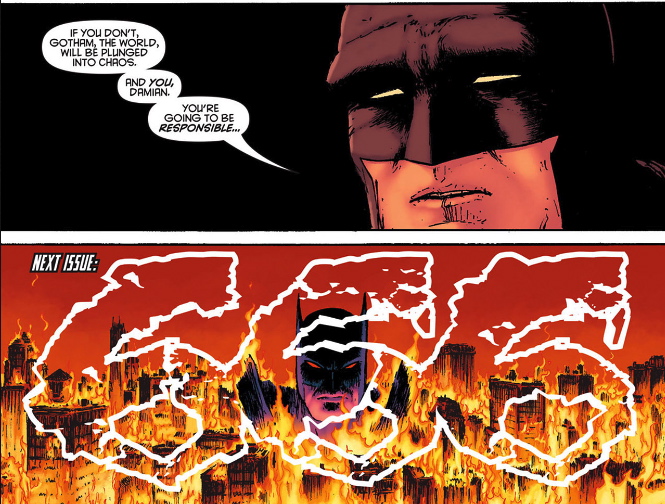
Morrison also plays with “future Damian,” one last time. We see that in this future, Dr. Hurt sits at the right hand of the President of the United States, and gets him to launch a nuclear strike on Gotham. The message is clear: If Damian is alive in the future, then evil does in fact win. Batman knows this because he saw the future (during the Return of Bruce Wayne) and so, once again, Morrison tells us that he plans to kill Damian.
There’s an element of classic Batman here, too. He’s planning for everything, again.
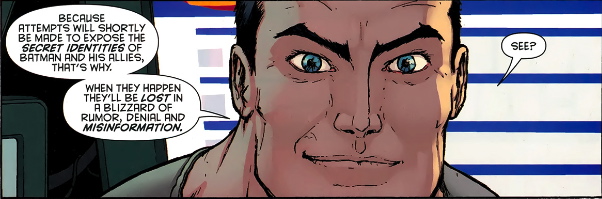
And it’s not just the multiple identities, it’s preparation for the final big bad:
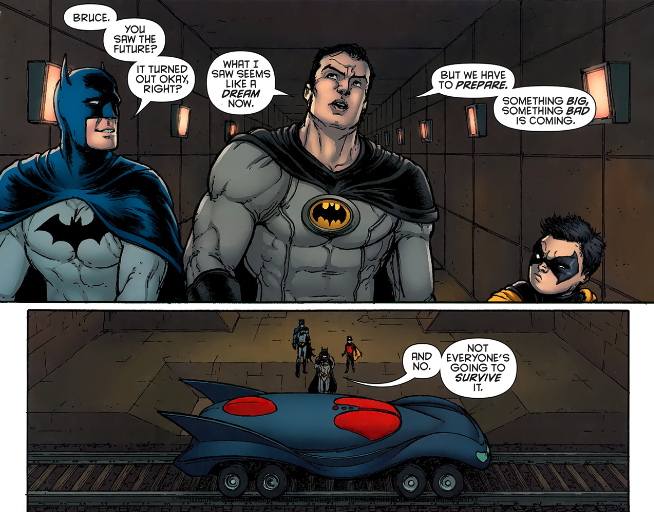
Anyone who says killing Damian (which happens in volume 2) was a marketing ploy suddenly concocted to boost DC’s lagging sales should go back. There’s been indications from the beginning that he would die.
Then, we get the double sized one shot “Leviathan Strikes,” which pretty much takes place at an all girls’ boarding school.
Production delays were crippling production of the title, and it went on hiatus so that Morrison and Chris Burnham could focus on publishing twelve, uninterrupted, on-time issues to conclude Morrison’s Bat-epic.
It ended up taking 14 issues, with two filler issues (one not written by Morrison).
It was during the final 14 that we really started to see Morrison getting worn out. I don’t know if it was because DC rebooted the Bat universe and pretty much ripped the carpet out from under him, or if there were other reasons, but it’s evident.
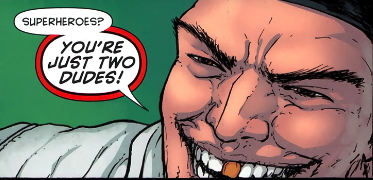
Anyway, by the end of volume one, he’s gotten investors to ensure that there’s a Batman in every country. Yeah, it’s like Tony Stark’s Avengers Initiative on steroids.
Batman has succeeded in his quest for international branding.
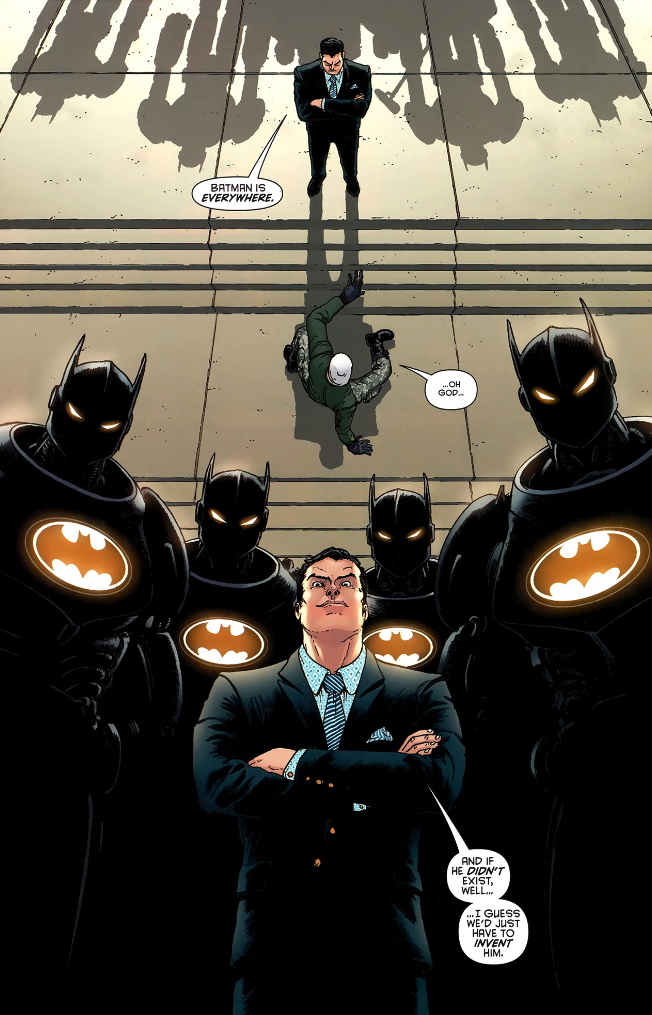
Bruce Wayne paraphrases Voltaire in this turning point of Morrison’s Batman saga.
Before now, you’d be forgiven for thinking that Morrison’s best Batman work was behind him. He killed Batman, proved that someone else could wear the cowl, and actually made the Dick Grayson Batman better than the Bruce Wayne one. (And he did it a lot faster than Brubaker proved that Bucky could be a better Captain America.) Batman and Robin was excellent and the Return of Bruce Wayne was fascinating, and it built to the promise of a worldwide group of Batmen. But the first five issues of that promise, Batman, Inc. Volume 1 #1-5, felt a little scattered. With this issue, he brings it all into focus and introduces the final conflict for his Batstory. The first act was about Bruce letting go of all the ideas he had about himself–all the disparate pieces of his past–and becoming a person capable of loving his family. The second act was about Batman’s role in the universe, both in present day Gotham in the guise of Dick Grayson and throughout history as Batman essentially went on a time-traveling walkabout to discover himself. This third act will be about whether a global force for justice can overcome a global force for evil.
Or, more precisely, if justice needs a specific face or if it is a mask that can be worn by many….
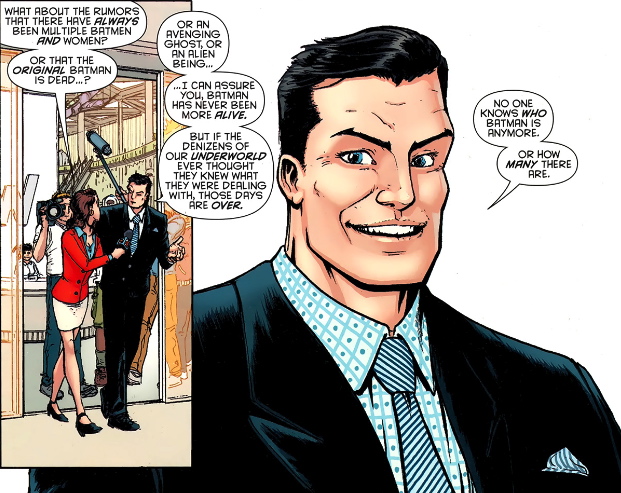
He goes so far as to allow himself to be seen with Dick–both wearing the cowl.
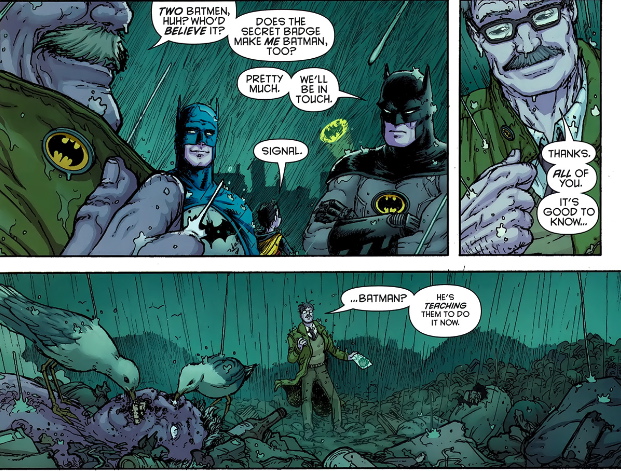
He also creates a “club.” Gordon gets to be in it.
Batman is becoming big, important–to important to see the death right in front of him. Eventually, all of Gotham will betray him and make him illegal because people fear power. In other words, he’s becoming the thing he fears the most. (Jason Todd later comes back as a major player in Batman, Inc.–further evidence that Batman has lost touch, because during the B&R comic Jason Todd was a vicious, murdering vigilante.)
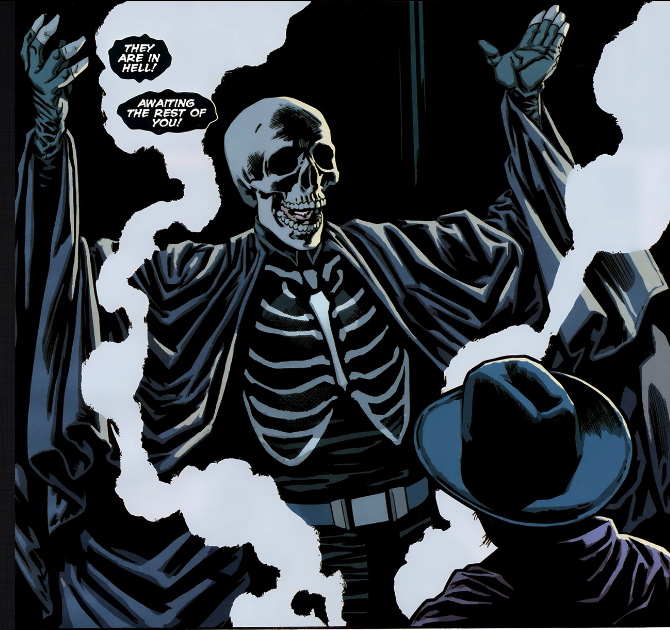
The first issue of the second volume of Batman, Inc., has a lot of set-up. The league of heroes comes back from the dead, undercover and pretending to still be dead. Leviathan has put a bounty on Damian Wayne’s head, and Damian gets shot and “killed.” Of course, he’s not dead yet–but he pretends to be during this first arc. The oddest thing about this issue, which ultimately doesn’t appear to have any significance, is Damian’s hood. Batman tells him to take it off or it will get him in trouble. But when Damian is shot, according to the narrative of the assassin, he’s not wearing the hood. But then when Batman is cradling Damian at the end, he does have his hood on.
I wish Morrison had played with this idea of the unclear/unreliable narrator more, but I think about this time he was starting to get pissed at DC for crapping all over his epic by rebooting their universe. And rightly so.
In Vol 2 #2, Batman explores the story of Talia Al Ghul, and a recap with a little extras in #0, which is largely filler and not written by Morrison.

These issues step out of the otherwise continuity-heavy saga.
One thing about these issues disturbed me: Why did they retcon Talia into such a young girl when she conceived with Batman?

Here’s what she looked like in the original issue, which I wrote about here.
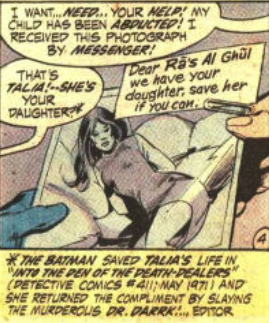
Like Batman in “Batman and Son,” Talia has become her mask. She does not exist if she is not Leviathan. And Leviathan has become more important than her family. It’s actually brilliant: Batman’s character arc over these 10 years of comics has been to embrace family and to see the Batman mask as something that can be worn by many people who are pure of heart and full of justice.
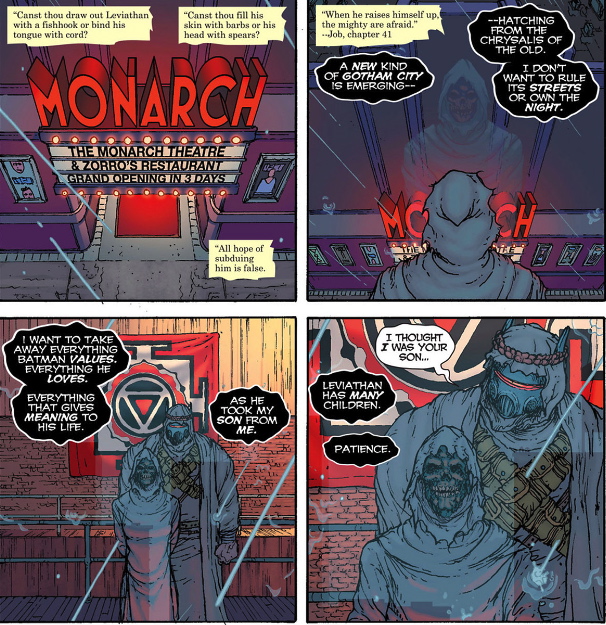
Talia started the arc as the doting mother who only wanted to be with Batman, but ends the arc a murderous beast whose sole purpose is to destroy her own offspring, as well as their father and the city that represents his soul. The Bible quotes are from the Book of Job. I’m not a religious guy, so someone else can do that analysis.
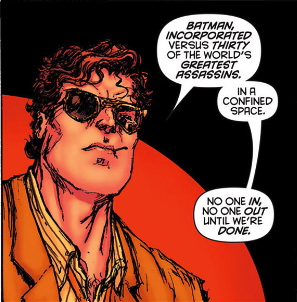
Back to the challenge of Leviathan.

I found this sequence absolutely chilling. In issue #3, Morrison establishes Leviathan’s reach. And, basically, they’ve reached everyone.

In the beginning, and throughout this epic, Gotham City belonged to Batman. In The Return of Bruce Wayne, we saw how the Wayne family was embedded into the very foundation of the city. But now, Leviathan is displacing Batman. Scott Snyder is trying something similar with his Court of Owls, but he’s not nearly as effective a writer.
Morrison is also showing us that he’s getting ready to conclude his run, tying everything together:

In issues #6-7, Batman follows a variation of the Buddhist path to enlightenment known as the Ten Bulls.
As a Buddhist myself (but not a Zen one), I found this a particularly interesting arc. The Ten Bulls are a series of illustrations and poems, which proceed sequentially through a goatherder’s journey. The first stage is the search for the bull…

…Morrison inserts Damian’s discovery of the cat he calls Alfie (who appears throughout the 666-timeline), and also has shots of Batcow as well–in case you missed the analogy.
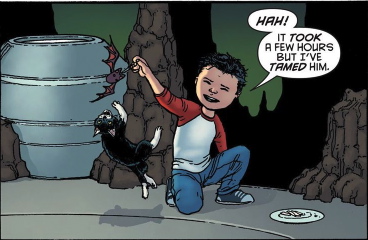
The next stages of the path involve finding footprints, seeing the ass of the bull, and catching it. Through the comic, Batman proceeds through the wreckage of a Leviathan headquarters, doing what the goatherder does in the parable. When he finally tames the goat–“a test of touch”–we see Damian doing the same. And there’s another brilliant connection there when Alfred offers to cover for Damian, who has been ordered to stay out of the battle.

Alfred offers to lie and say Damian overpowered him to steal the costume–which Damian actually did way back in Batman and Son. Damian has tamed Alfred, or at least wooed him. Or maybe it’s Damian who has become domesticated?
Ultimately, Batman reaches the top of the building, and proceeds to the final frame, in which he is supposed to return to society, Talia’s other, bigger son (known as The Heretic) catches Batman and hurls him off the top of the building. Batman falls, just like Gordon fell in the opening frame of Batman and Son, where all of this began.
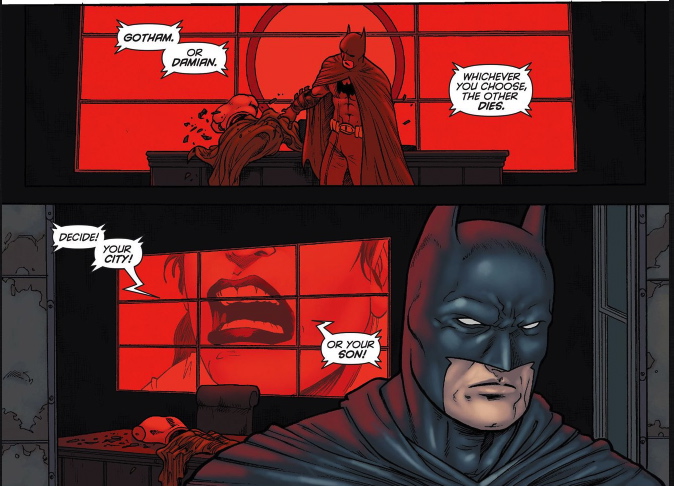
But through it all, Batman refused to make the Sophie’s Choice offered by Talia in the beginning: Give up Damian or give up Gotham.
And so the final battle begins, to stop Talia from exploding the Oroboros bomb in Gotham City.
At last, the prophecy of Damien’s death comes true.

The above panel is a wonderful tribute to one of the best movies ever, Butch Cassidy and the Sundance Kid. It’s followed by this tragic panel of Damian dead.

Note: This time, he saved the girl. Remember in Batman and Robin, Damian failed to save a girl from having the Dollytron mask grafted to her face, which led her to become an evil “Robin” to Jason Todd’s evil “Batman.” All of these characters are being redeemed through this arc.
The death-panel is also a mirror of the panel where Damian wasn’t dead, in Batman Inc. #1, as well as many, many death panels throughout Morrison’s run.
